


![Falcon Chair Office Chairs Falcon Chair [Free Footrest Worth $150] Ergoworks](http://ergoworks.com.sg/cdn/shop/files/Falcon_A.png?v=1786502358&width=104)



![Ergoworks Dual Benching Electric Desk [Customizable] Dual Benching Electric Desk Ergoworks](http://ergoworks.com.sg/cdn/shop/files/EW-0223H-2.jpg?v=1778755296&width=104)





![Impact Junior Desk Chair Set Impact Ergonomic Kids Desk & Chair Set [Chair & Length Options Available] Ergoworks](http://ergoworks.com.sg/cdn/shop/files/KidDeskMainImageFinal.png?v=1778618207&width=104)
![Impact Junior Desk Chair Set Impact Ergonomic Kids Desk & Chair Set [Chair & Length Options Available] Ergoworks](http://ergoworks.com.sg/cdn/shop/files/gray_ff76a24f-26d1-469b-b2d5-0013d4a950d7.jpg?v=1785487301&width=104)




Key Takeaways
-
Shallow, chest-dominant respiration increases background muscle activity in the neck and shoulders, contributing to gradual tightness across the workday.
-
Chair configuration and torso positioning influence how freely the diaphragm moves, affecting overall muscular effort during seated tasks.
-
Sustained screen focus can subtly alter respiratory rhythm, increasing upper body load even when posture appears visually aligned.
-
Long-term comfort depends on integrating structural support with natural, unrestricted respiratory movement rather than relying on alignment alone.
Introduction
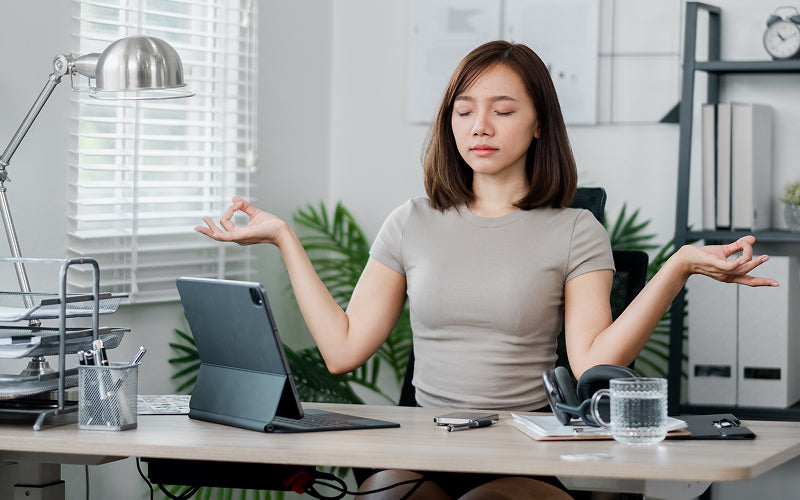
In many workplace discussions, discomfort is often attributed solely to posture or prolonged sitting. While these factors matter, they do not tell the full story. During long hours at a desk, subtle shifts in breathing patterns can significantly influence muscle activity in the neck, shoulders, and upper back.
For working professionals, students, and remote employees in Singapore, understanding this link offers a more complete view of upper-body tension during desk work.Even when a workstation appears well adjusted, persistent tightness may be influenced by how the body breathes under sustained focus and structured seating support. This becomes especially relevant in hybrid work environments, where long screen hours are often distributed across both office and home setups.
How Reduced Breathing Depth Increases Muscle Load at Your Desk
Breathing depends on coordinated movement between the diaphragm, rib cage, and surrounding stabilising muscles. When the diaphragm moves efficiently, the shoulders and neck are able to remain relatively relaxed during seated tasks. However, when breathing patterns become shallow or chest-dominant, the body compensates by recruiting muscles around the collarbone and upper ribs to assist inhalation.
What Happens When Your Neck and Shoulders Start Assisting Your Breath
This shift increases muscle activity in the upper body, often without conscious awareness. Instead of resting between typing, reading, or screen transitions, the neck and shoulder muscles maintain a low level of contraction to support chest expansion. Over time, this sustained engagement increases baseline muscle demand and contributes to desk-based muscle strain. Rather than experiencing a full release between tasks, the upper body remains in a state of continuous low-level effort. Discomfort may build gradually, even when posture appears visually aligned.
Why Your Chair Design Can Quietly Restrict Your Breathing
Seating design directly shapes how freely the torso can expand and contract. A seat pan that positions the hips too far back, or a backrest angle that compresses the lower ribs, can limit diaphragm movement. When the torso remains confined for extended periods, breathing patterns often become shallower and more contained.
In Singapore’s compact home offices and study rooms, efficient layouts sometimes prioritise space-saving over torso mobility. Selecting well-designed ergonomic office furniture supports spinal alignment while allowing the rib cage to expand naturally during focused work. Adequate seat depth, backrest contour, and dynamic support all influence whether the torso can move comfortably throughout the workday.
How to Check If Your Seating Setup Limits Torso Movement
Subtle restrictions in chair configuration can influence respiratory freedom over time. If your shoulders rise noticeably when you inhale, or if your lower ribs feel firmly pressed into the backrest, the torso may not be moving optimally. Restricted expansion increases reliance on upper body muscles to stabilise the trunk. Ensuring that your seating setup allows natural rib cage movement helps reduce unnecessary strain and improves coordination between breathing mechanics and physical discomfort. Small observational checks like these provide early cues before tightness becomes persistent.
Why Sustained Screen Focus Changes Your Breathing Without You Noticing
Extended screen engagement and cognitive concentration can alter respiratory rhythm. As attention narrows, breathing often becomes slower and shallower. These altered breathing patterns reduce diaphragm contribution and shift movement higher into the chest.
As a result, the upper body adopts a stabilising role that was not designed to be maintained for prolonged durations. This gradual redistribution of effort contributes to increased neck and shoulder tightness, particularly when head position remains fixed during virtual meetings or extended document review. In high-focus tasks common in corporate environments, this subtle change can persist for hours without conscious awareness.
Why Ergonomic Support Alone May Not Fully Release Upper Body Tension
Supportive seating and workstation alignment reduce external strain, yet they do not automatically restore natural respiratory mechanics. A well-designed support chair improves load distribution and posture, but breathing behaviour remains an independent factor influencing muscle engagement. While structural alignment provides the foundation, habitual breathing patterns can either reinforce or counteract that support.
What to Adjust When Tension Persists Despite Proper Alignment
When discomfort continues despite good alignment, it is important to consider respiratory habits alongside structural support.
If breathing remains shallow during concentrated tasks, the shoulders and neck may continue operating at elevated tension levels. Introducing periodic posture resets and allowing the rib cage to expand fully can help interrupt this cycle. Structural support and respiratory awareness work together to sustain comfort rather than function separately. Even brief moments of intentional movement can restore natural coordination between the diaphragm and the upper body.
What Happens When Breathing-Related Tension Builds Across the Workday
Small changes in breathing behaviour may feel insignificant in isolation. Across hours of desk activity, however, repeated restriction in breath depth prevents the upper body from fully releasing muscle effort. Instead of returning to a resting state, the neck and shoulders maintain subtle activation.
Even with a properly fitted posture support chair, tightness may develop by late afternoon. Understanding how breathing mechanics interact with muscular endurance helps explain discomfort that persists despite a well-configured workstation. Recognising this pattern allows earlier adjustments rather than waiting for discomfort to intensify.
How Breathing Fits Into a Broader View of Ergonomic Support

Upper body comfort reflects coordination between spinal alignment, circulation, muscle endurance, and breathing patterns. Viewing discomfort purely as a posture issue overlooks this interaction. Sustainable comfort is shaped by how seating, work habits, and respiratory behaviour influence one another throughout the day.
For professionals setting up home offices, parents selecting study furniture for their children, and organisations investing in workplace wellbeing, this perspective supports more informed ergonomic decisions.
If persistent tightness continues despite good posture, your workstation may not be supporting natural torso movement as effectively as it should. Visit Ergoworks to discover ergonomic solutions designed to support spinal alignment and encourage more natural breathing throughout the workday.



Leave a comment
This site is protected by hCaptcha and the hCaptcha Privacy Policy and Terms of Service apply.